A Hybrid BVH Structure for Interactive GPU Ray Tracing
Andrew Bauer and Yining Karl Li
ACM SIGGRAPH 2026 Talks. Article No. 57
Abstract
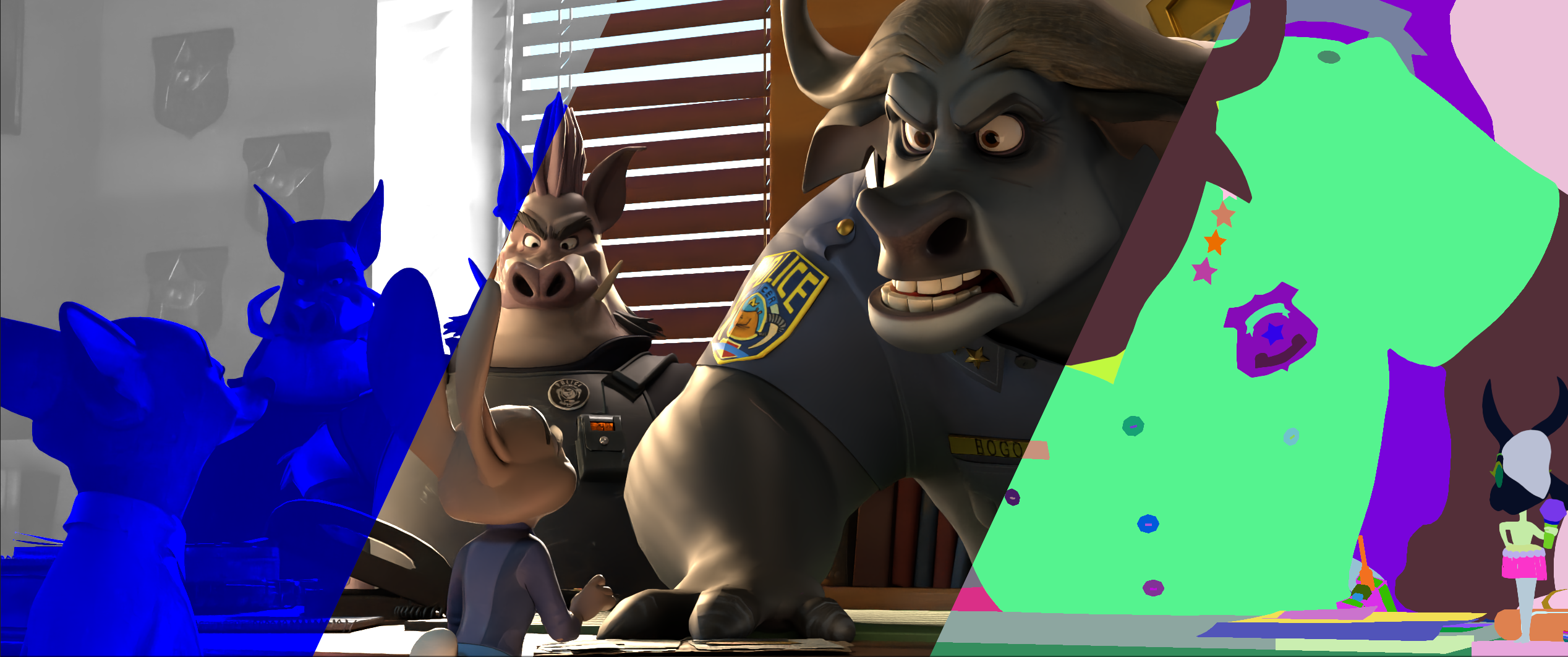
Choosing a bounding volume hierarchy (BVH) structure for accelerating ray tracing applications typically involves trading off between BVH build/update speed and BVH traversal speed. Two-level BVHs offer faster build/update speeds but lower traversal performance and can still have degraded build speed in pathological cases common to production scenes, while monolithic single-level BVHs provide ideal traversal performance but suffer from slower worst-case build speeds. We introduce a hybrid approach that combines the strengths of both while minimizing their downsides. Our system places instanced objects into a two-level BVH, while non-instanced objects are partitioned into three separate monolithic sub-BVHs based on specific change categories. This allows us to optimally determine when to use reuse, refit, or rebuild operations for maximum update efficiency. Our approach supports high-performance, interactive GPU ray tracing of complex production scenes, maintaining fluid updates even during real-time animation playback or active geometry editing by an artist.
Text Reference
Andrew Bauer and Yining Karl Li. A Hybrid BVH Structure for Interactive GPU Ray Tracing. ACM SIGGRAPH 2026 Talks. Article 57, Jul 2026.
Bibtex Reference
@inproceedings{Bauer2026HybridBVH,
	author = {Bauer, Andrew and Li, Yining Karl},
	title = {A Hybrid BVH Structure for Interactive GPU Ray Tracing},
	booktitle = {ACM SIGGRAPH 2026 Talks},
	month = jul,
	year = {2026},
	articleno = {57},
	doi = {10.1145/3799818.3812105},
}
Acknowledgements
We thank Mark Lee for his key contributions to previous versions of our interactive ray tracer's BVH system, which provided foundational lessons for our modern system. We also thank Daniel Teece and Mackenzie Thompson for their leadership, support, and guidance on this project, and we thank all of the early users of our interactive ray tracer at Disney Animation for their support and feedback.
Copyright Disclaimer
© The Author(s) / ACM. This is the author's version of the work. It is posted here for your personal use. Not for redistribution. The Definitive Version of Record is available at doi.acm.org.